Even beyond the educators striving to make a difference are those in many other fields pushing for change. What do you value? Do you have the courage to raise up for those values? Can we inspire the best in all we come in contact with as well?
Wednesday, January 28, 2009


Tuesday, January 27, 2009
Scattered thoughts...
From multiple sources including Educon comes the following quotes and thoughts that are thought provoking. I am not going to find resources for (this is the echo chamber, is it not?) As I reflect and rework what I do, I will be documenting on this blog continous reflection about the following:
From Karl Fisch:
My thoughts; I have really made a move for continuous collaboration and reworking through content and scaffolding. Students rework content in new creations and present through the wiki but need to work at different formats and more differentiation. Time to ask: What am I valuing?
From Barry Bachenheimer:
My self-assessments need fine tuned to include what they missed during the learning process, how they re-learned, what ways of learning were meaningful to them, an action plan of what to do differently next time, etc. Has anyone used such a self-assessment?
From David Warlick: (Which sums up the pieces currently missing in my instruction. View the original and check the links.)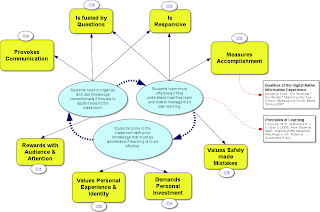 My focus:
From Relevance of Science session at Educon:
This is something that has been troubling me - the focus on content (yes, I know there is a test and that PA kids performed miserably. Is it really because we are not teaching content or is it because that is all we are focused on?) My mission is to not focus on big PBL as much as inquiry and really looking at how they weave through the content. In speaking with my colleague, I believe we are doing this, but sometimes we are more effective than at other times. A good debriefing at the end of the year to see what worked and did not is a good idea (oh, and it will include student voices too.)
From Values Driven Education - What do we believe? at Educon:
No quote, just a thought. Time to really look and document what I value. Is the atmosphere I provide as well as the educational opportunities in line with the values? Is our mission statement something we do at kids, or something we are doing for kids?
Project-based learning session from Educon:
Panel session on Sunday:
Human capital is the most important resource and the solution to most problems. Time to embrace and support that.
From Dennis Richards Catalyst session:
Still a question no one can answer: How do you convey to other leaders that learning is still happening if you do this? I am a firm 100% believer in this, but know many that think there is no learning unless they see the "Sage on the Stage" model.
A tweeted gem of a quote from Jasmine, SLA student:
And from the Constructivism and Inquiry session:
... the frank discussion of how to move to inquiry reinforced many of the thoughts and problems I have encountered. SLA teachers are the best at this as it is the core of the way they teach and connecting with others who use (vs. talk about it) is the best way to challenge and reinforce your thinking. Now the hard part, refining use of inquiry in our mess of a science curriculum. How can we arrange and change courses to best capitalize on the use of process and increasing opportunities for students? (we can change things now, but does our department have the courage to look at the big picture and create change?)
Stay tuned as I continue to wrestle with these and challenge my thinking and practices.
Tags: Karl Fisch, Barry Bachenheimer, Chris Lehmann, SLA, Dennis Richards, David Warlick, educon
From Karl Fisch:
Do you believe schools foster inquiry and passion in students? If so, are your schools currently structured to do that? Are students regularly asked to research, collaborate, create, present and network in your schools? If not, what can you do to change that."
My thoughts; I have really made a move for continuous collaboration and reworking through content and scaffolding. Students rework content in new creations and present through the wiki but need to work at different formats and more differentiation. Time to ask: What am I valuing?
From Barry Bachenheimer:
We need to unlearn that teachers give all classroom assessment. Students need to learn how to self-assess and self-reflect in order to help build independence in their learning. (There are many more in this unlearn list created by University students.)
My self-assessments need fine tuned to include what they missed during the learning process, how they re-learned, what ways of learning were meaningful to them, an action plan of what to do differently next time, etc. Has anyone used such a self-assessment?
From David Warlick: (Which sums up the pieces currently missing in my instruction. View the original and check the links.)
 My focus:
- Look at how students organize and use knowledge. Use inquiry, collaboration, and continuous feedback.
- Focus on different learning opportunities for all to succeed. Using continuous feedback (more blogging), differentiated learning opportunities, learning from mistakes.
- Tap into prior knowledge. Individual inquiry opportunities using the content and valuing unique perspectives and interests.
From Relevance of Science session at Educon:
"How can you rephrase the standards to make it more process oriented?"
This is something that has been troubling me - the focus on content (yes, I know there is a test and that PA kids performed miserably. Is it really because we are not teaching content or is it because that is all we are focused on?) My mission is to not focus on big PBL as much as inquiry and really looking at how they weave through the content. In speaking with my colleague, I believe we are doing this, but sometimes we are more effective than at other times. A good debriefing at the end of the year to see what worked and did not is a good idea (oh, and it will include student voices too.)
From Values Driven Education - What do we believe? at Educon:
No quote, just a thought. Time to really look and document what I value. Is the atmosphere I provide as well as the educational opportunities in line with the values? Is our mission statement something we do at kids, or something we are doing for kids?
Project-based learning session from Educon:
"Kids are not apathetic - they just believe they are powerless." When kids show passion about what they are learning (generally tied to a problem in society), how can we help them use the information and feel power? ...and... "Failure is okay - kids who grow up to be great social entrepreneurs had some point where students felt safe to make a mistake and try it again."Maybe grading of learning opportunities should not be a big part of the grade. The use of the information learned towards a bigger gain should be graded but allowed the opportunity to redo until they have learned. What can I do to create projects that make a difference? My personal issue I also need to work on: Start small!
Panel session on Sunday:
Chris Lehmann: "The reason some schools work is processes and habits of mind...Systems and structures in place so all the teachers can be good and excellent...Give good people the freedom and the structure...Can't cut them off from their joys and their passions.
Also: "Need to be about the right things, not catching people at doing bad things." "How do we look at children? They are not someone we get to proficient. They need to be honored and loved to be the best they can be at what they are passionate about. The scores will come.
Human capital is the most important resource and the solution to most problems. Time to embrace and support that.
From Dennis Richards Catalyst session:
"Let the teacher step out of the roll between the student and the knowledge" and "Thinking is the most important. the person who controls the learning owns the learning."
Still a question no one can answer: How do you convey to other leaders that learning is still happening if you do this? I am a firm 100% believer in this, but know many that think there is no learning unless they see the "Sage on the Stage" model.
A tweeted gem of a quote from Jasmine, SLA student:
"You cannot be a student without being a teacher and you can't be a teacher without being a student"
And from the Constructivism and Inquiry session:
"Process is more important"
... the frank discussion of how to move to inquiry reinforced many of the thoughts and problems I have encountered. SLA teachers are the best at this as it is the core of the way they teach and connecting with others who use (vs. talk about it) is the best way to challenge and reinforce your thinking. Now the hard part, refining use of inquiry in our mess of a science curriculum. How can we arrange and change courses to best capitalize on the use of process and increasing opportunities for students? (we can change things now, but does our department have the courage to look at the big picture and create change?)
Stay tuned as I continue to wrestle with these and challenge my thinking and practices.
Tags: Karl Fisch, Barry Bachenheimer, Chris Lehmann, SLA, Dennis Richards, David Warlick, educon
Sunday, January 18, 2009
A question of simple logic...
Thanks to John Connell for a wonderful post about Intelligent Design and a lack of critical thinking on behalf of lawmakers. He writes a wonderful exchange of an inquisitive critical thinking child asking questions about Intelligent Design. I could quote here, but you should read the post in its entirety.
As a science teacher, the misunderstanding of facts and the inability to question and look objectively, critically is something that will not serve society well. We are already demonstrating how our lack of understanding has created problems.
As a science teacher, the misunderstanding of facts and the inability to question and look objectively, critically is something that will not serve society well. We are already demonstrating how our lack of understanding has created problems.
Tuesday, January 13, 2009
Science Education elsewhere...
Thanks to Tim at Assorted Stuff about this bit on Hands-On Learning and Physics courses at MIT:
Tags: ASCD, Seattle Times, science education
The physics department has replaced the traditional large introductory lecture with smaller classes that emphasize hands-on, interactive, collaborative learning...and this from the ASCD News Brief and reported in the Seattle Times:
M.I.T. is not alone. Other universities are changing their ways, among them Rensselaer Polytechnic Institute, North Carolina State University, the University of Maryland, the University of Colorado at Boulder and Harvard. In these institutions, physicists have been pioneering teaching methods drawn from research showing that most students learn fundamental concepts more successfully, and are better able to apply them, through interactive, collaborative, student-centered learning.
I can only hope that these initiatives have momentum and cause some change. Most, I think, believe those of us who have made great sweeping changes in the classroom are off the path, but I believe we are on to something. How to assess this is definitely a problem, but we know science education as we know it is broken and time to really look at what all kids need to be able to do (especially think critically and inquire.)The first revision of the state's science education standards since 2003 is organized into four essential learning requirements across all grades from kindergarten to 12th grade. All children should be able to accomplish:
-Systems thinking to analyze and understand complex phenomena.
-Inquiry activities to develop understanding of scientific ideas.
-Application of the science they are learning to solve real-world problems.
-Understanding of the domains of science: physical science, life science, and earth and space science.
Under these categories come more specific goals concerning the core content kids are supposed to learn at different grade levels.
The new standards require teachers to cover fewer concepts per year, but to do so in a deeper way. The document does not tell teachers how to teach; it provides an outline of the path of learning kids should follow to gather certain science knowledge by the time they graduate from high school
Tags: ASCD, Seattle Times, science education
Sunday, January 11, 2009
Sure reading scores are going up...
Thanks to Clay Burrell and his post in education.change.org (if you have not stopped there, you need to). This video from Daniel Willingham discusses reading and comprehension.
As our district contemplates the dismal failure of students on the PSSA science tests (we are actually average, so the whole state stinks), one has to wonder why. Without looking at the actual questions, here are some thoughts:
As our district contemplates the dismal failure of students on the PSSA science tests (we are actually average, so the whole state stinks), one has to wonder why. Without looking at the actual questions, here are some thoughts:
- Elementary science scores are higher. The test is either very easy or it is about things kids already do have knowledge about.
- As you go higher through school, science is specialized. Not every student takes a chemistry course. They may have had the concepts in a physical science class, but those students traditionally do poorly and have not had that material in years.
- Remedial time has been spent on Math and Reading strategies and practice in order to pass those tests. This may be to help them but has a negative connotation. Would it not be better to help all students with interesting reading selections that challenge students (like literature circles?)
- The questions asked are not in line with the standards. There may have been a disproportionate number of chemistry questions compared to the number of chemistry state standards.
- Students know it does not count for graduation. do you think that had an effect?
- Who cares? Does knowing a few facts mean anything in todays world if you do not know what to do with it? This of course means that how we teach science and structure curriculum still has to change completely.
Wednesday, January 7, 2009
It's okay to ask!
Teacher's First is a wonderful resource providing great links and wonderful examples for using the vast array of websites on the Internet today.
They are even going one better with a series of live, online sessions for discussing and sharing ideas for integrating technology tools in the classroom. These sessions include Teacher's First staff (which are classroom teachers) modeling the use of tools and resources.
Choose from these sessions:
Tags: Teacher's First, education, technology
They are even going one better with a series of live, online sessions for discussing and sharing ideas for integrating technology tools in the classroom. These sessions include Teacher's First staff (which are classroom teachers) modeling the use of tools and resources.
Choose from these sessions:
- Find It, Use It: Exploring the Resources of Teacher's First to Plan Effective, Technology-Infused Lessons
- A Safe Journey to the Edge: Intro to Web 2.0 Tools
Tags: Teacher's First, education, technology
Tuesday, January 6, 2009
I am pop-tastic

Claire Thompson nominated me for the pop-tastic award. The pop-tastic awards highlight bloggers that are not very well known but have inspired others in some way. Thanks Claire! The best part of the award (for those who think it is pretty silly) is finding other great blogs you may not have heard about.
Here are the Rules & Regs for the bling:
- When you receive The Award, please post it on your blog, linking back to the person who gave it to you.
- Please visit Veggie Mom’s Post , which explains the origins of The Award, and Sign Mr. Linky, so she’ll be able to keep a record of all whose Blogs are Pop-tastic! Feel free to leave a comment, too!!
- Pass The Award along to SIX Bloggy Friends, whose creativity merits inclusion in this circle. Link to their blogs in your Awards Post, and notify them that they’ve received The Award.
Sunday, January 4, 2009
Competition...
"A competitive culture endures by tearing people down."
Jules Henry, Culture Against Man
I ask: Do we have the courage to make changes in the way we learn and operate in this World?
Jules Henry, Culture Against Man
I ask: Do we have the courage to make changes in the way we learn and operate in this World?
Saturday, January 3, 2009
A thought on using wikis...
Students like the wiki because they can work together but ultimately may not like it as much as a conventional class because they have to think much harder through material.
Dr. Wesch's post about why he uses participatory social media with urgency has one part that really sticks with me:
Add to this the eye opening idea that the media can be used for more than the advertisement of their weekend cavorting. Students really do not know a) what different media are out there and b) how to really leverage their power.
Tags: Dr. Wesch, wikispaces
Dr. Wesch's post about why he uses participatory social media with urgency has one part that really sticks with me:
Ultimately, participatory media literacy is as much about a literacy of *participation* as it is a literacy of media. For, as Howard says, “a participatory culture in which most of the population see themselves as creators as well as consumers of culture is far more likely to generate freedom and wealth for more people than one in which a small portion of the population produces culture that the majority passively consume.”Those who are part of the movement now and use it well, will help pave the way for a different world in which media moves. The top down and locked media that is created and distributed by a few may not be our future as much as it was our past.
Add to this the eye opening idea that the media can be used for more than the advertisement of their weekend cavorting. Students really do not know a) what different media are out there and b) how to really leverage their power.
Tags: Dr. Wesch, wikispaces
Friday, January 2, 2009
Literacy vs. skill
Skills are easily checked off of a list.
A few thoughts from a elluminate session today led by will Richardson and attended by many great educators around the world.
The discussion focused on Literacy and what that means. Some old discussion we have heard before and some new discussions as well.
Some snippets:
A few thoughts from a elluminate session today led by will Richardson and attended by many great educators around the world.
The discussion focused on Literacy and what that means. Some old discussion we have heard before and some new discussions as well.
Some snippets:
- Skills are items that can be checked off of a list. Literacies are habits of mind. Literacy allows you to make sense of the world.
- From @Sylvia: "I think a teachers job is to funnel down some of the messy world and help students navigate pieces that add up to a bigger idea."
- From Angela Maiers: "I think the most telling interview question for a new teachers should be: Tell me about something you have recently learned"
- There were many others, but the chat was fast and furious.
"Pedagogy, schmedagogy..."
Wes Fryer's post concerning "WOW" type changes in education and technology and those that affect pedagogy is much of what I have been thinking lately. It is all meaningless unless it causes change in instruction for students.
He offers some great information (I am not going into the wow information in the post) about technology that enhances pedagogy and the learning experiences of students.
As our district is looking to go to one-to-one computing, we were invited to give concerns and comments on that move via survey. One of my biggest problems is the focus on the flashy things we can do when the pedagogy itself has not changed. A worksheet given as a word document online is no different than the same worksheet handed out on paper. If this is what we do, then the move to one-to one will have more headaches than cures.
Listen up!
I loved the part of the post that discusses chemistry teachers reworking how they teach. Students are generally left alone to "practice" the parts of class that are the most difficult at home and where they actually need the most help. The easy stuff, listening to lectures, is done in class. Really, we lecture, they nod their understanding, we give them an assignment, and then what...
...they don't get it. They scratch their heads, and we do it again.
Their article linked in the original post from ISTE is password protected for members, but a news article about these remarkable teachers can be seen here:
What if like the example, we assign podcasts of lectures to be done at home? Students can listen to it as many times as needed, make notes of questions to ask in class, and maintain for a reference. We can require notes to be shown for evidence of work having been done.
The hard work can be done in class. Or the application of the material, a project or extension activity...
In Biology, much of the hard work is understanding the terminology and how it relates to other concepts. Some of the hardest parts of Biology is Biochemistry, Respiration, and Photosynthesis. I have actually thought about using podcasts in class but have not. What has stopped me? Lack of time. I teach 3 different classes and can't even keep up at this point. But, will the shift from some project-based learning activities to a different model of learning for students be the right course right now? Is not doing this giving less than the 100% I am striving to achieve this year? Is the reinventing myself of last year the best, or do I need to reinvent further?
Reflection
Currently, much of the project activities I have designed have students working through and learning material as they are completing the assignment. What if we get some of the information out of the way first? This is actually counter to the other arguments made in the past where working with real world activities are necessary to learn the material effectively.
I have found that students have learned a lot being deeply immersed in content as they are learning. But I am also struggling with a few of my classes not getting there. Most of the time it is still lack of motivation, lack of skill, and generally stumbling over the language of the curriculum and most sites they must navigate. I do lecture minimally, and have been thinking I may need more at this point in the year. Most would agree that not one strategy works with all content.
I do not want to be the educator who finds one way and only does that. That would mean I remained stuck in a particular teaching pattern. I am actually looking at the best ways to differentiate instruction for all of my students.
I really do not view this as a flitting around from idea to idea, but using the best examples out there to craft the best learning environment for my students. Most of what we have today does not change because of the argument of "what if..?" I am thinking, "Why not...?"
Tags: Wes Fryer, podcasting, podcast, vodcast, lecture, education, technology, iste
He offers some great information (I am not going into the wow information in the post) about technology that enhances pedagogy and the learning experiences of students.
As our district is looking to go to one-to-one computing, we were invited to give concerns and comments on that move via survey. One of my biggest problems is the focus on the flashy things we can do when the pedagogy itself has not changed. A worksheet given as a word document online is no different than the same worksheet handed out on paper. If this is what we do, then the move to one-to one will have more headaches than cures.
Listen up!
I loved the part of the post that discusses chemistry teachers reworking how they teach. Students are generally left alone to "practice" the parts of class that are the most difficult at home and where they actually need the most help. The easy stuff, listening to lectures, is done in class. Really, we lecture, they nod their understanding, we give them an assignment, and then what...
...they don't get it. They scratch their heads, and we do it again.
Their article linked in the original post from ISTE is password protected for members, but a news article about these remarkable teachers can be seen here:
What if like the example, we assign podcasts of lectures to be done at home? Students can listen to it as many times as needed, make notes of questions to ask in class, and maintain for a reference. We can require notes to be shown for evidence of work having been done.
The hard work can be done in class. Or the application of the material, a project or extension activity...
In Biology, much of the hard work is understanding the terminology and how it relates to other concepts. Some of the hardest parts of Biology is Biochemistry, Respiration, and Photosynthesis. I have actually thought about using podcasts in class but have not. What has stopped me? Lack of time. I teach 3 different classes and can't even keep up at this point. But, will the shift from some project-based learning activities to a different model of learning for students be the right course right now? Is not doing this giving less than the 100% I am striving to achieve this year? Is the reinventing myself of last year the best, or do I need to reinvent further?
Reflection
Currently, much of the project activities I have designed have students working through and learning material as they are completing the assignment. What if we get some of the information out of the way first? This is actually counter to the other arguments made in the past where working with real world activities are necessary to learn the material effectively.
I have found that students have learned a lot being deeply immersed in content as they are learning. But I am also struggling with a few of my classes not getting there. Most of the time it is still lack of motivation, lack of skill, and generally stumbling over the language of the curriculum and most sites they must navigate. I do lecture minimally, and have been thinking I may need more at this point in the year. Most would agree that not one strategy works with all content.
I do not want to be the educator who finds one way and only does that. That would mean I remained stuck in a particular teaching pattern. I am actually looking at the best ways to differentiate instruction for all of my students.
I really do not view this as a flitting around from idea to idea, but using the best examples out there to craft the best learning environment for my students. Most of what we have today does not change because of the argument of "what if..?" I am thinking, "Why not...?"
Tags: Wes Fryer, podcasting, podcast, vodcast, lecture, education, technology, iste
Moving towards 100%...
From Vicki Davis:
In the past, it was crafting projects that allowed students to express themselves in different ways and find success in the way that they chose. I am still not sure I am giving opportunities for success to everyone.
In her post, she also asks if we give 100%. I am sure I haven't. The past 2 years have been the roughest in my life and has been an immense distraction. I struggle to remain in the present. I know how defeating that is and am sure other students view their lives similarly. A little encouragement is necessary and I cannot do that being just a deliver of content.
What will this look like. I don't know yet, but I have my eyes open.
My New Year's goal is to be 100% right now at what I am doing (personal and professional.) I think continual re-invention and reflection is necessary.
Tags: Vicki Davis, education
In this day of tests and measurements, God forbid we forget the main thing. Teachers who love their students, who customize their environment to help every child find a place they can contribute and succeed. Teachers who help their kids feel like winners because they do good HONEST work - (I'm not for telling kids they are great no matter what they do - kids see through it as a sham.)
In the past, it was crafting projects that allowed students to express themselves in different ways and find success in the way that they chose. I am still not sure I am giving opportunities for success to everyone.
In her post, she also asks if we give 100%. I am sure I haven't. The past 2 years have been the roughest in my life and has been an immense distraction. I struggle to remain in the present. I know how defeating that is and am sure other students view their lives similarly. A little encouragement is necessary and I cannot do that being just a deliver of content.
What will this look like. I don't know yet, but I have my eyes open.
My New Year's goal is to be 100% right now at what I am doing (personal and professional.) I think continual re-invention and reflection is necessary.
Tags: Vicki Davis, education
Subscribe to:
Posts (Atom)